Independent evidence library
See Kazakhstan beyond the shortcut.
For international readers who encounter inaccurate claims about Kazakhstan — in films, memes, travel guides or conversation. Short, sourced explanations with evidence you can check.
- 35
- public explainers
- 185
- visible sources
- 35
- claim-audited articles


Who this is for
You heard something about Kazakhstan. You want to know if it's accurate.
Maybe a colleague mentioned it's "basically Russia." Maybe you saw a Borat reference used as a fact. Maybe a travel forum described the country as dangerous steppe with no cities. This site gives you sourced context to distinguish the shorthand from what's actually checkable.
It is not written for Kazakhstanis who already know their own country. It is written for people outside it who want to replace assumptions with evidence.
"Kazakhstan is part of Russia."
"Everyone there lives in yurts."
A short verdict + the evidence behind it, with sources you can open and check.
Choose your way in
Three ways to replace a shortcut with context.
Play
Test your picture
15 questions, immediate evidence and a result you can share.
Start challenge → 02Experience
Scroll through the myths
One visual object follows 35 familiar claims and the patterns behind them.
Open visual story → 03Learn
Get the essentials
A concise orientation to modern Kazakhstan before you explore deeper evidence.
Understand in 60 seconds →The evidence loop
Useful in the moment, inspectable afterwards.
Check
Start with the exact claim.
Ask matches your wording against published explainers without sending it to an AI model.
Inspect
Follow the evidence path.
Claim IDs, confidence labels, sources and unresolved limitations stay visible.
Carry
Share context, not a slogan.
Reusable evidence cards preserve the verdict, review date and canonical source link.
Flagship explainer
See how one word changes the whole story.
“Kazakhstan has no notable world heritage or recognized cultural traditions”
Kazakhstan Has Seven UNESCO World Heritage Sites and Rich Cultural Traditions
False. As of July 2026, Kazakhstan has seven UNESCO World Heritage properties — four cultural and three natural — and 14 elements on UNESCO's Intangible Cultural Heritage lists. The record spans Timurid architecture, rock art, Silk Road archaeology, steppe and mountain ecosystems, desert landscapes, sacred sites and living traditions.
Latest evidence
Recently added or rechecked.
“Kazakhstan is always freezing and uninhabitable”
Kazakhstan Has a Diverse Climate, Not Permanent Extreme Cold
Misleading. Kazakhstan has a strongly continental climate with hot summers and cold winters, but conditions vary enormously by region and season. The south has mild winters and warm springs; the north has extreme winters; the mountains support skiing; the steppe heats above 30°C in July. No single climate label fits the whole country.
“AI assistants accurately describe Kazakhstan”
AI Models Have Significant Gaps in Their Knowledge of Kazakhstan
Misleading. Benchmark research shows that major AI language models perform measurably worse on Kazakhstan-specific knowledge — particularly in Kazakh language and local context — than on general English-language topics. Models routinely produce outdated, simplified, or conflated information about Kazakhstan's geography, language, institutions, and history.
“Almaty is not seriously at risk from earthquakes”
Almaty Has a Significant and Well-Documented Earthquake Risk
False. Almaty is officially classified in Kazakhstan's highest seismic hazard zone. The city sits near active faults in the Tian Shan mountain system, was largely destroyed by earthquakes in 1887 and 1911, and records hundreds of minor tremors per year. Authorities maintain earthquake preparedness plans and seismic monitoring systems.
Quick answers
Common questions about Kazakhstan
Is Kazakhstan the country from Borat?
No. Borat is a fictional character created by British comedian Sacha Baron Cohen. The films were shot in Romania and the US — the language, customs, and geography shown are invented satire. Full fact-check →
Is Kazakhstan part of Russia?
No. Kazakhstan is a fully independent UN member state since 1991 with its own government, currency (tenge), and foreign policy. Full fact-check →
Does Kazakhstan still have nuclear weapons?
No. Kazakhstan transferred all Soviet-era warheads to Russia by 1995 and signed the NPT. It has been nuclear-weapon-free for over 30 years. Full fact-check →
What is the capital of Kazakhstan?
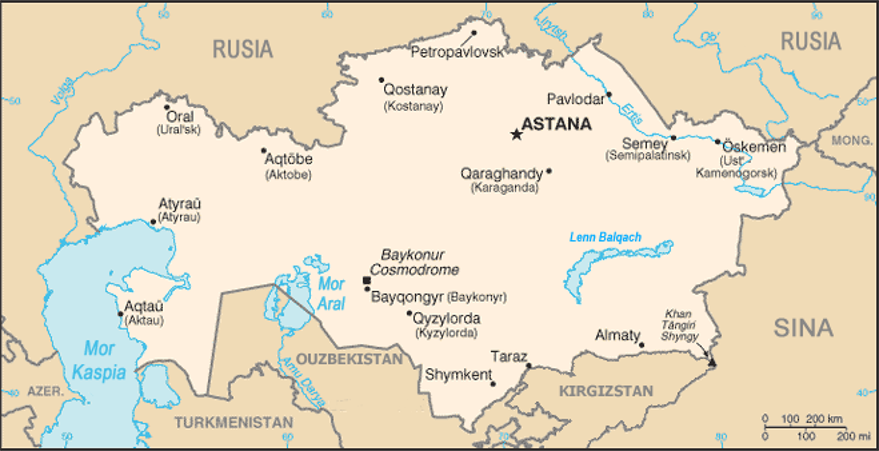
Astana. The capital moved from Almaty in 1997, was briefly renamed Nur-Sultan (2019–2022), and is now called Astana again. Almaty is the largest city but not the capital. Full fact-check →
Is the Aral Sea completely gone?
Partly. The southern section largely dried up. The northern North Aral Sea on the Kazakhstan side partially recovered after the Kok-Aral Dam (2005) — fishing has resumed. Full fact-check →
Is Kazakhstan only steppe and desert?
No. Kazakhstan contains the Tian Shan and Altai mountains, forests, rivers, the Caspian coast, and major cities. The steppe is one biome among several. Full fact-check →
Does Kazakhstan have UNESCO World Heritage Sites?
Yes — seven as of July 2026: four cultural and three natural properties. The newest is the Rock Mosques and Associated Sacred Sites of Mangystau. Full fact-check →
Is Kazakhstan always very cold?
Misleading. The north has severe winters, but summers across Kazakhstan regularly exceed 30°C. Southern cities like Almaty average 24–26°C in July. The country has four distinct seasons. Full fact-check →
How big is Kazakhstan?
About 2.7 million km² — the world's ninth-largest country and the largest landlocked country. That is larger than Western Europe. Full fact-check →
Use on your phone
Keep Qazaq Lens one tap away.
Core explainers can be saved to your home screen and remain available when the connection drops.
Manual installation instructions
Android / Chrome: open the browser menu and choose Install app or Add to Home screen.
iPhone / Safari: tap Share, then choose Add to Home Screen.
Why this exists
"I kept seeing the same wrong claims repeated — in conversations, in travel content, in AI responses. There was no short, linkable, sourced place to send people. So I built one."
— Dulat Nurlanuly, creator of Qazaq Lens
The project started as a personal frustration: accurate information about Kazakhstan existed, but it was scattered across academic papers, government documents and long-form journalism. None of it was optimised for the moment when someone needs a quick, honest answer to a specific claim. Qazaq Lens is an attempt to close that gap — one checked claim at a time.
Read more about the project →Qazaq Lens does not claim that Kazakhstan is problem-free, and it does not speak for every Kazakhstani. Its job is narrower: separate checkable context from fiction, shorthand and overconfident generalization.