The answer in 20 seconds
Kazakhstan has four distinct seasons and its climate varies enormously by region. The north has severe winters; the south has mild winters and hot summers; the mountains have permanent snow. The country is home to 19 million people and significant agriculture — including wheat production that ranks it among the world’s largest exporters. “Always freezing” does not describe it accurately.C1
Why the stereotype persists
Kazakhstan’s climate reputation is shaped by a few specific, real facts:
- Astana (the capital) is consistently listed among the world’s coldest capitals, with January averages around −15°C and occasional lows of −40°C.
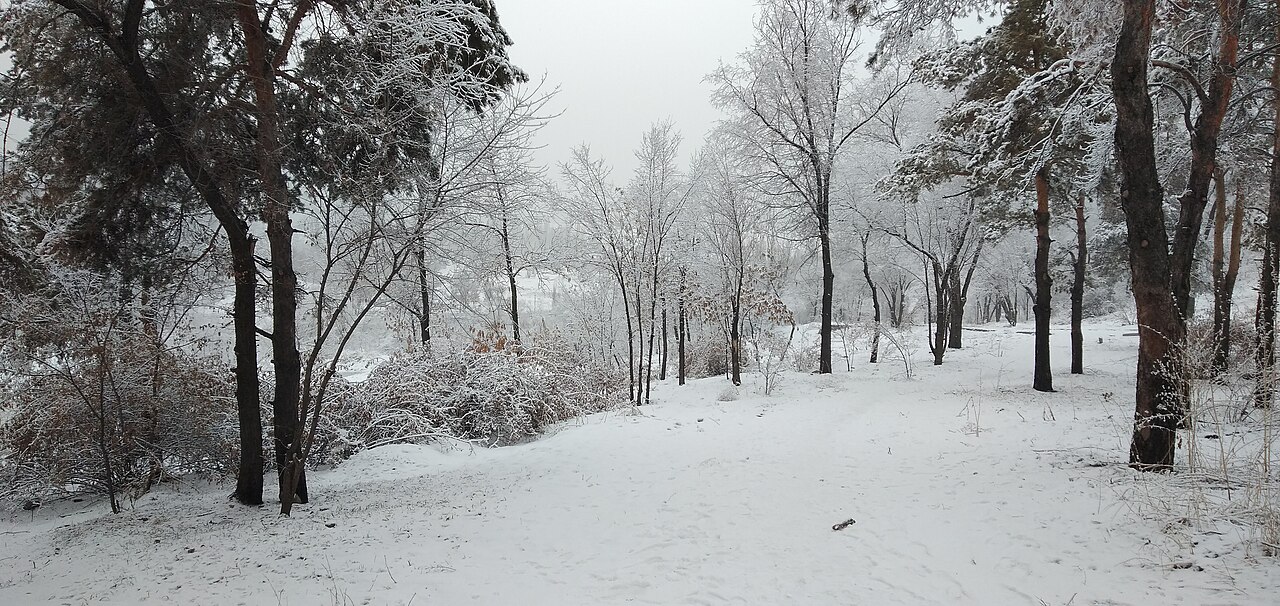
- Images of the steppe in winter — flat, snow-covered, windswept — circulate online and look forbidding.
- Soviet-era documentation often described the harsh conditions of the steppe for agricultural settlement.
These facts are accurate for parts of Kazakhstan in winter. The problem is generalisation: applying them to the whole country and the whole year.
The regional picture
Kazakhstan spans more than 2,700 km from north to south, and climate changes significantly across that distance.C2
Northern Kazakhstan (Astana / Petropavl)
- January average: approximately −15°C to −18°C
- July average: approximately 21–24°C
- Continental extremes: hot summers, very cold winters
Southern Kazakhstan (Almaty / Shymkent)
- January average: approximately −3°C to −5°C
- July average: approximately 24–26°C
- Mild winters, warm springs, hot summers
Western Kazakhstan (Atyrau / Aktau on the Caspian)
- Drier, more arid; hot summers (35°C+), moderate winters
Mountain regions (Tian Shan / Altai)
- Permanent snow at elevation, alpine meadows below snow line, ski resorts operating around Almaty year-round
Summer conditions
Across most of Kazakhstan, summer temperatures are comparable to Central European summer norms — or hotter.C3
July averages in major cities:
- Astana: approximately 21–24°C
- Almaty: approximately 24–26°C
- Shymkent: approximately 27–30°C
- Aktau: approximately 28–32°C
Heatwaves are common in the steppe belt. Kazakhstan is not an Arctic climate.
The mountains: a different world again
The Tian Shan range south of Almaty and the Altai mountains in the east add yet another climate layer.C4
- Glaciers persist year-round at higher elevations.
- Shymbulak ski resort operates near Almaty at 2,200–3,200 metres altitude.
- Alpine meadows (zhailyau) are used for summer grazing as they have been for centuries.
- The Charyn Canyon and surrounding landscapes near Almaty can feel like a desert in summer and a snowfield in winter.
Why people can live there
The claim that Kazakhstan is uninhabitable is contradicted by basic facts:C5
- Population: approximately 19–20 million people live there.
- Agriculture: Kazakhstan is a significant global producer of wheat, sunflower oil and livestock products.
- Urban life: cities of several hundred thousand people are spread across the steppe.
- Tourism: Almaty hosts international ski and hiking tourism year-round.
A country with major agricultural output and a population of 19 million is not an uninhabitable wasteland.
What the continental climate actually means
“Continental” climate — which Kazakhstan genuinely has across most of its territory — means large temperature swings between seasons and limited moderating influence from ocean air. Summers are often hot; winters are often cold; precipitation is lower than coastal areas; seasonal variation is dramatic.
This is distinct from “extreme year-round cold.” People in Moscow, Minneapolis, Stockholm, Ulaanbaatar or Nur-Sultan adapt to continental winters without living in uninhabitable places.
What can be said accurately
- Winters in the north and central steppe can be very severe, with significant cold periods and wind.
- Astana is one of the coldest capitals in the world, which is a real and notable fact.
- Almaty in the south has a very different climate — more comparable to parts of Central Europe.
- Summers across Kazakhstan can be hot, sometimes uncomfortably so.
- The mountains are a separate climate zone again.
Accurate wording
Say “Kazakhstan has a strongly continental climate with cold winters in the north and hot summers across most of the country”, not “Kazakhstan is always freezing” or “it’s too cold to visit.”
Where this claim appeared
- Reddit r/travel — Questions about visiting Kazakhstan frequently receive answers like “it’s freezing cold there” or “brutal winters make it hard to visit”; summer conditions are rarely mentioned (reddit.com/r/travel)
- Google autocomplete — “Kazakhstan weather” reliably surfaces winter imagery and temperatures without context about the summer half of the year or southern regional variation
- Travel forums (TripAdvisor, Lonely Planet) — Multiple threads about Kazakhstan describe it primarily as a cold destination; southern and mountain tourism in warmer months is underrepresented
- Western news media — Coverage of Kazakhstan often emphasizes the steppe’s severity in a way that generalises to the whole country and the whole year
Reader context
Comments
Comments are moderated before publication. Keep them specific, sourced and respectful.
No published comments yet. Add the first useful context.