The Claim
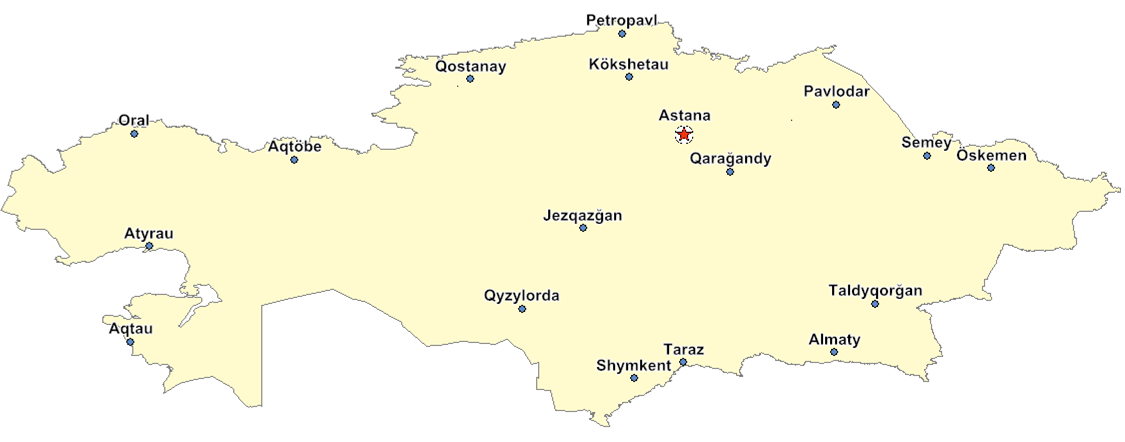
Kazakhstan is sometimes described or mentally categorised as a small or peripheral country — a post-Soviet remnant with little global significance. This is factually incorrect on the most basic geographic measure.
Land Area
Kazakhstan covers 2,724,900 km² [C1][S1][S5]. By land area it ranks:
| Rank | Country | Area (km²) |
|---|---|---|
| 1 | Russia | 17,098,242 |
| 2 | Canada | 9,984,670 |
| 3 | United States | 9,833,517 |
| 4 | China | 9,596,960 |
| 5 | Brazil | 8,515,767 |
| 6 | Australia | 7,692,024 |
| 7 | India | 3,287,263 |
| 8 | Argentina | 2,780,400 |
| 9 | Kazakhstan | 2,724,900 |
| 10 | Algeria | 2,381,741 |
Kazakhstan is larger than every country located entirely within Europe, every country in the Middle East, and every country in Southeast Asia.
Largest Landlocked Country
Kazakhstan is not just the ninth-largest country — it is the largest landlocked country on Earth [C2][S1]. No country without ocean access has more territory.
Comparison to Europe
A useful scale reference: using the UN Statistics Division area figures [S5], Kazakhstan’s 2,724,900 km² is slightly larger than the combined area of France, Germany, Spain, Italy, the United Kingdom, Poland, and Sweden together (~2,714,964 km²) [C3]. Its width from west to east is approximately 3,000 km — similar to the distance from Lisbon to Moscow.
| Country | Area (km²) |
|---|---|
| France | 543,940 |
| Germany | 357,114 |
| Spain | 505,990 |
| Italy | 301,336 |
| United Kingdom | 243,610 |
| Poland | 312,679 |
| Sweden | 450,295 |
| Combined | 2,714,964 |
| Kazakhstan | 2,724,900 |
Why Smallness Is Assumed
The confusion typically arises from population, not area. Kazakhstan has approximately 20.5 million inhabitants [C4][S3] — a population comparable to Romania — distributed across nearly 2.7 million km². The resulting density of roughly 7–8 people per km² is one of the lowest in the world.
Low population density is not the same as small size. Australia (25 million people, 7.7 million km²) is universally perceived as a large country. Kazakhstan’s similar density pattern is simply less familiar to international audiences.
Economic Scale
Kazakhstan is the largest economy in Central Asia by GDP [C5][S2][S4]. Its oil sector, significant uranium reserves (the world’s largest), agricultural output, and growing logistics sector give it regional economic weight disproportionate to its population size.
Time Zones and Geographic Span
Kazakhstan unified its clocks to a single time zone (UTC+5) on 1 March 2024, ending a previous split between multiple offsets. Despite this administrative unification, the country spans roughly 3,000 km from the western Caspian coast near Atyrau to the eastern border with China near Almaty — comparable to a drive from Lisbon to Moscow. Crossing the country by train requires several days.
Borders and Geopolitical Weight
Kazakhstan borders Russia (7,644 km — the world’s second-longest land border between two countries), China, Kyrgyzstan, Uzbekistan, and Turkmenistan. It also has a Caspian Sea coastline of approximately 1,894 km. The length of its border with Russia alone exceeds the combined border length of most European nations.
This geographic position — between two permanent UN Security Council members — gives Kazakhstan structural geopolitical relevance that small countries cannot claim.
Why the Myth Persists
Three factors sustain the “small Kazakhstan” framing:
- Population mismatch — ~20 million people distributed across 2.7 million km² produces a low international profile. Most countries with Kazakhstan’s area have far larger populations and therefore more cultural presence globally.
- Regional lumping — Kazakhstan is sometimes discussed as part of a generic “Central Asia” grouping without distinguishing countries by size. The five Central Asian countries vary dramatically in area.
- Soviet geography — Maps of the USSR often showed Kazakhstan as one administrative division among many equal-looking blocks, obscuring its relative scale.
Summary
The “small Kazakhstan” framing collapses when tested against basic data. By land area, it is the ninth-largest country in the world and the largest landlocked country in history. The confusion stems from conflating low population density with smallness — a category error applied less often to Australia or Canada than to Central Asian states.
Reader context
Comments
Comments are moderated before publication. Keep them specific, sourced and respectful.
No published comments yet. Add the first useful context.