The answer in 20 seconds
Oil and gas are the dominant export and a major source of state revenue, so the dependency is real.C2 The economy is not exclusively oil, however. Kazakhstan is also the world’s largest uranium producer, a significant metals and grain exporter, and host to a financial, retail and services sector in its major cities.C3 The World Bank classifies Kazakhstan as an upper-middle income economy.C1
The oil economy is real and significant. Reducing it to the only story omits uranium, metals, grain, finance and a large urban economy.
What oil and gas actually contribute
Hydrocarbons — primarily from the Tengiz, Kashagan and Karachaganak fields — account for a large share of Kazakhstan’s export value and government revenue.C2 Oil price swings have driven visible fluctuations in public spending, currency stability and GDP growth. This dependence is a well-documented structural challenge that policymakers, the IMF and the OECD have all noted explicitly.C5
Acknowledging oil’s importance is accurate. Describing it as the country’s only economic activity is not.
What else the economy includes
Uranium and metals
Kazakhstan is the world’s largest producer of uranium, providing a substantial share of global supply through state company Kazatomprom.C3 Beyond uranium, Kazakhstan exports copper, zinc, lead, ferroalloys and chromite. The country hosts large deposits of manganese, bauxite and rare earth elements. These are not minor side activities — they form a distinct export pillar that long predates the oil boom.
Agriculture
Kazakhstan is a major wheat exporter and one of the larger grain producers in the former Soviet space. It also produces barley, sunflower oil, cotton and livestock products. The agricultural sector employs a significant rural population and contributes measurably to GDP.C4
Manufacturing, construction and services
GDP composition data show that manufacturing, construction, trade, financial services and transport together account for a large share of economic activity.C4 Major cities — Almaty and Astana in particular — have substantial banking, retail, logistics, telecom and technology sectors that employ large numbers of workers outside the extractive industries.C6
Dependence is not the same as exclusivity
Two statements can be true at the same time. Kazakhstan is more exposed to oil and gas than a diversified manufacturing economy, and Kazakhstan is not an economy made only of oil wells. Hydrocarbon exports influence trade, public revenue, investment and the tenge, especially when global prices move sharply. That is why “oil dependence” is a defensible structural criticism.
Export concentration should not be confused with the composition of every job, business or regional economy. Services, trade, construction, agriculture, transport, metals and uranium all employ people and generate value. A capital-city office, a grain producer in the north, a copper operation in the east and an oil field in the west belong to one national economy while facing different risks.
Diversification has a geography
The diversification story is uneven. Almaty has a large services, finance, retail and technology base; Astana concentrates administration, construction and professional services; western regions remain closely tied to hydrocarbons; northern and eastern regions have stronger agricultural, industrial and mining profiles. National averages can hide those differences, so a responsible account should identify both resource exposure and the sectoral variety beneath it.C4
Transport is another part of the picture. Kazakhstan’s position between China, Russia, the Caspian Sea and Central Asia gives rail, road and logistics projects economic importance beyond extraction. The Middle Corridor does not eliminate oil dependence, but it shows why the country’s economic geography cannot be reduced to a single commodity.C7
Income level
The World Bank’s upper-middle income classification means Kazakhstan’s per-capita income is in a range comparable to countries like Mexico, Brazil, Colombia and China — not the category of the poorest oil-reliant states. The OECD has engaged Kazakhstan formally as a partner economy, recognising its economic complexity.C1
Why the simplification persists
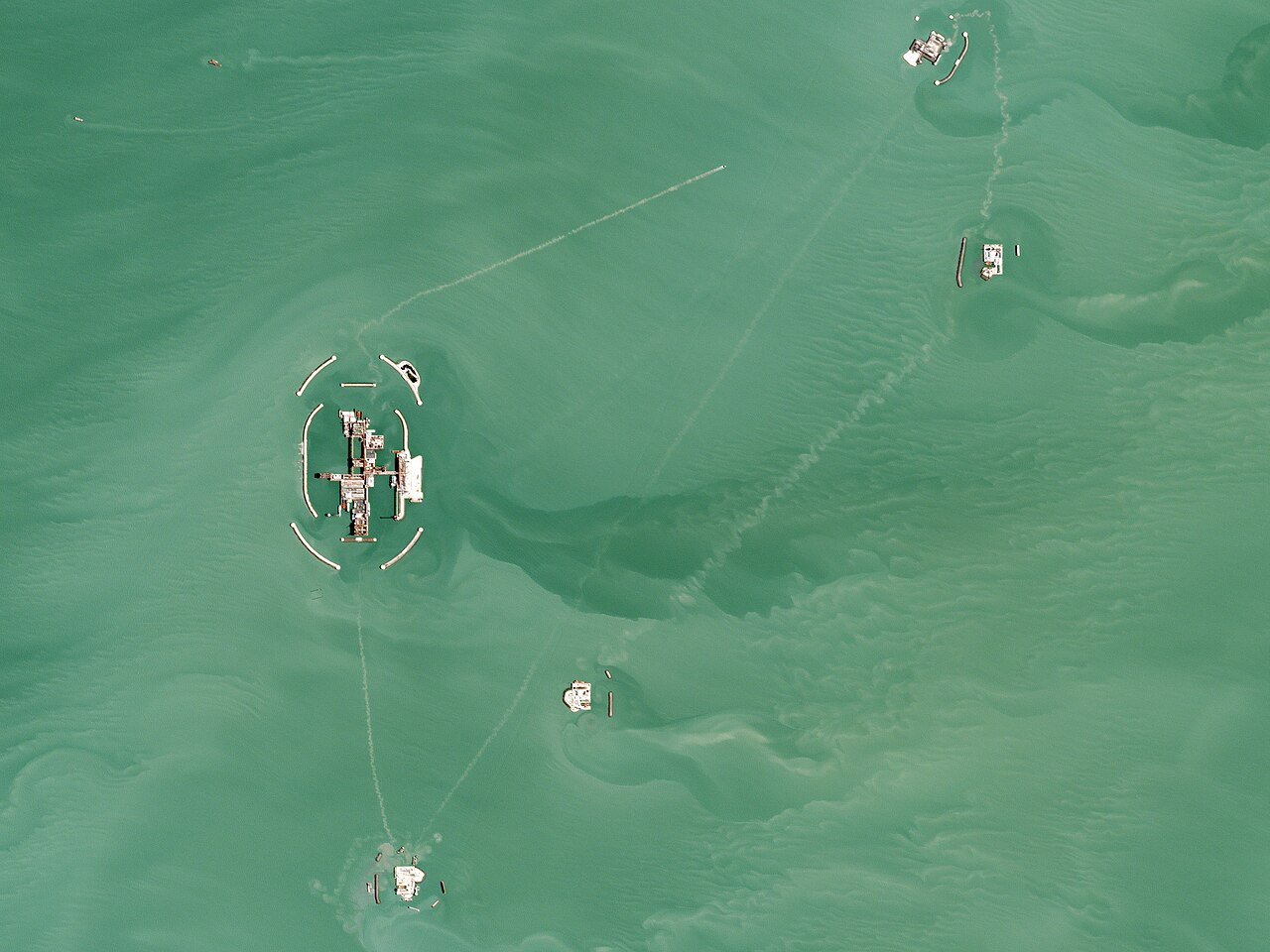
Oil infrastructure — pipelines, offshore platforms, refinery towns — is visually dramatic and easy to photograph. It generates large foreign investment flows that appear in financial news. International commodity markets track Kazakhstani oil directly. Agriculture and manufacturing, by contrast, are less visible in international media unless there is a crisis.
The result is a picture of Kazakhstan in which oil is the only thing that registers — not because the other sectors are absent, but because they receive less coverage relative to their actual economic weight.
The Middle Corridor and the geography of trade
Kazakhstan’s location between China, the Caspian Sea, Russia and Central Asia gives transport a strategic role beyond extraction. The Trans-Caspian International Transport Route — often called the Middle Corridor — links rail, road and maritime segments between Asia and Europe. In February 2026, the World Bank approved an $846 million guarantee intended to mobilise $1.41 billion in commercial financing for rail connectivity in Kazakhstan.C7
This does not mean Kazakhstan has already become a post-oil economy. It means the country’s economic story includes infrastructure, transit capacity and regional integration as well as wells and pipelines. The honest conclusion is mixed: diversification is real, investment is substantial, and dependence on commodities remains a constraint.
The honest qualification
The oil-dependency critique contains a real concern: Kazakhstan’s budget and currency have historically been exposed to energy-price swings, diversification efforts have produced uneven results, and the resource-rich regions are not the same economy as the services-heavy cities.C5 These are legitimate analytical points. They support “oil-dependent economy” — not “only oil.”
Where this claim appeared
- The Economist “Kazakhstan: The oil giant” — Multiple pieces from 2005–2015 framed Kazakhstan’s economic identity almost entirely through its Kashagan and Tengiz oilfields (economist.com)
- Bloomberg (2014) — A country profile described Kazakhstan as “Central Asia’s oil-dependent economy” without noting agricultural exports, metals, or the growing financial sector (bloomberg.com)
- Reddit r/investing — Threads on Central Asian investment routinely describe Kazakhstan as “basically just an oil country” with no other notable sectors (reddit.com/r/investing)
- Forbes (2019) — A piece on Kazakhstan’s “petrostate” status was widely shared and became a reference point in subsequent media coverage (forbes.com)
- World Bank country overview — While accurate in full, the summary statistic on oil’s share of exports (often cited at ~60%) is routinely misread as oil equaling the entire economy (worldbank.org/en/country/kazakhstan)
Reader context
Comments
Comments are moderated before publication. Keep them specific, sourced and respectful.
No published comments yet. Add the first useful context.