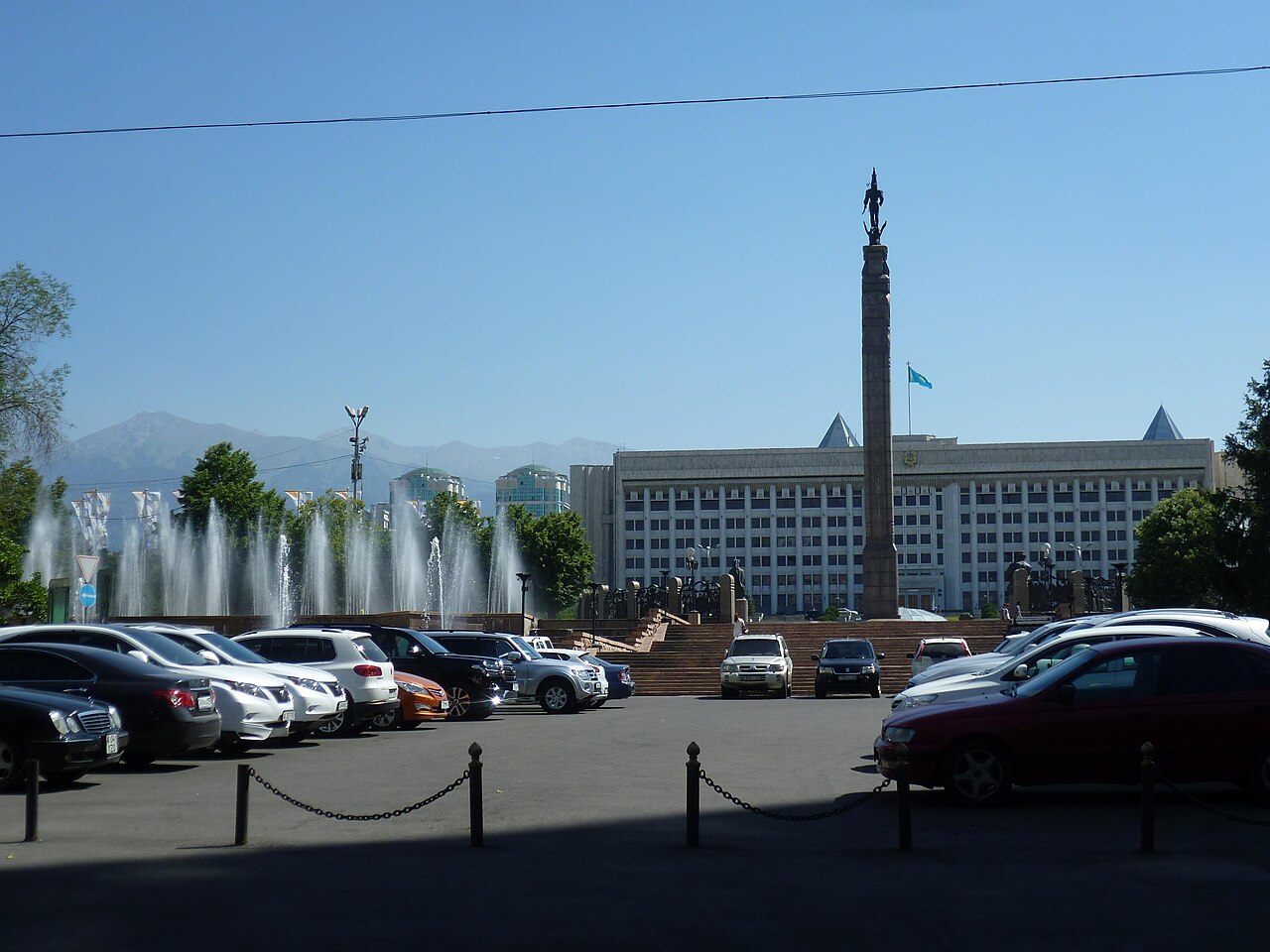
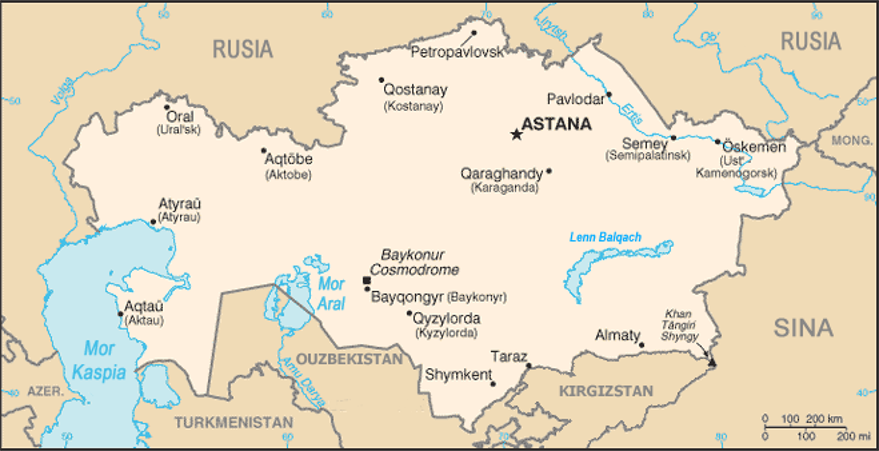
 Real geographic reference map · CIA World Factbook via Wikimedia Commons · public domain
The answer in 20 seconds
Kazakhstan is not a Russian region. It is a sovereign state with its own constitution and membership in the United Nations.C1
Why does the confusion happen?
Several overlapping facts produce this misconception:
- Kazakhstan was a constituent republic of the Soviet Union for decades, which some people conflate with being part of Russia
- Russian is widely spoken in Kazakhstan and used in many official contexts
- Kazakhstan shares a border with Russia that is over 7,500 kilometres long — one of the longest land borders in the world
- Historical ties, shared infrastructure, economic integration and security arrangements create visible closeness
Each of those facts is real. None of them makes Kazakhstan Russian territory. A long-shared border and historical ties describe geography and politics, not legal sovereignty.
The historical layers behind the confusion
The relationship has more than one historical layer. Russian imperial administration expanded into the Kazakh steppe during the eighteenth and nineteenth centuries, while Kazakh social and political life continued through local structures, changing forms of authority and resistance. In the Soviet period, Kazakhstan became the Kazakh Soviet Socialist Republic — one constituent republic of the USSR — rather than a province of the Russian Soviet Federative Socialist Republic.
That distinction matters because “Russian,” “Soviet” and “Kazakh” are not interchangeable labels. Russian institutions, migration and language had a profound influence on Kazakhstan, but influence is not the same as legal incorporation into the Russian Federation.
Soviet history and the path to independence
The Kazakh Soviet Socialist Republic was one of fifteen constituent republics of the USSR. It was not a region of Russia proper (the Russian Soviet Federative Socialist Republic); both were separate republics within the same federal structure.
When the Soviet Union dissolved in 1991, fifteen independent states emerged. Kazakhstan was among them. Kazakhstan declared independence in December 1991 — the same month the Soviet Union formally ceased to exist. It subsequently became a member of the United Nations as a separate state.C2
Kazakhstan’s own institutions
Since 1991, Kazakhstan has operated its own presidency, parliament, constitution, judiciary, central bank, military, currency (the tenge), foreign policy and diplomatic service. It joined the United Nations, the Organisation for Security and Co-operation in Europe, the Shanghai Cooperation Organisation and other international bodies as a sovereign state — not as a Russian territory.C1
Relations with Russia
Kazakhstan maintains close ties with Russia through multiple frameworks: the Eurasian Economic Union (economic integration), the Collective Security Treaty Organisation (security), shared infrastructure and large cross-border communities. Those ties are real and politically significant.
Close ties and shared membership in regional organisations do not mean subordination. Kazakhstan has consistently pursued what its foreign policy community calls a “multi-vector” approach — maintaining relations with Russia, China, the European Union, the United States and other partners simultaneously. On several high-profile international disputes, Kazakhstan has not automatically aligned with Russian positions.C3
What sovereignty looks like in practice
Sovereignty is not measured by cultural distance or by whether a country belongs to regional organisations. It is visible in institutions: Kazakhstan issues its own passports and currency, elects and appoints its own state officials, controls its own territory, signs treaties in its own name and maintains diplomatic relations independently. Russia can be Kazakhstan’s largest or most important partner in a particular area without becoming the sovereign of Kazakhstan.
The same principle applies to the Eurasian Economic Union and the Collective Security Treaty Organisation. These are treaties entered into by separate states. Membership creates obligations and coordination; it does not dissolve the members into one country.
What is partly true?
Kazakhstan and Russia share a long border, Russian remains widely used, Soviet infrastructure still connects the two economies, and the countries cooperate through regional organisations. Those facts explain why the relationship can look unusually close from outside. They do not overturn the basic answer: Kazakhstan has its own citizenship, territory, constitution, currency, armed forces and diplomatic representation.
Calling Kazakhstan “a Russian region” also hides the country’s own choices. Kazakhstan can cooperate with Russia while maintaining ties with China, Europe, the United States, Türkiye and other partners. Partnership is a political relationship; sovereignty is a legal status.
The careful conclusion
The most accurate description is neither “Russia and Kazakhstan have nothing in common” nor “Kazakhstan is basically Russian.” The two countries share imperial and Soviet history, a border, families, trade, language use and security arrangements. Kazakhstan is nevertheless a separate post-Soviet state with its own national history and political choices. A good explanation keeps both parts visible instead of using closeness as a substitute for sovereignty.
More accurate wording
Use “Kazakhstan, a country in Central Asia” rather than “a Russian region” or “part of Russia.” When discussing Soviet history, distinguish the former Kazakh Soviet Socialist Republic from the independent Republic of Kazakhstan that exists today.
Where this claim appeared
- Reddit r/geography — “Is Kazakhstan part of Russia?” appears as a recurring question; several threads from 2020–2023 show upvoted comments confidently stating it is or was (reddit.com/r/geography)
- Quora — “Was Kazakhstan ever part of Russia?” and “Is Kazakhstan a Russian country?” are among the most-viewed Kazakhstan questions on the platform, with millions of views combined (quora.com)
- Twitter/X — During Russia–Ukraine coverage in 2022, numerous posts described Kazakhstan as “Russia’s southern region” or “a Russian state”; the claim briefly trended in some language communities
- Google autocomplete — “Kazakhstan is a part of…” reliably completes with “Russia” in multiple languages, reflecting how frequently the query is typed
Reader context
Comments
Comments are moderated before publication. Keep them specific, sourced and respectful.
No published comments yet. Add the first useful context.